

Gold Export Rules in DR Congo : Complete 2025-2026 Guide to Legal Procedures, Licenses, Taxes,
Gold Export Rules in DR Congo: The Democratic Republic of the Congo (DRC) is one of Africa’s top gold producers, with significant artisanal and small-scale mining (ASM) output alongside growing industrial production.
However, exporting gold legally from the DRC is complex, heavily regulated, and requires strict compliance to avoid severe penalties, confiscation, or international sanctions.
This in-depth guide covers everything you need to know about DRC gold export rules, updated for the current regulatory environment.
Why Understanding DRC Gold Export Regulations Matters
Gold smuggling costs the DRC billions in lost revenue annually and fuels conflict in eastern provinces. The government, through the Ministry of Mines, has intensified reforms to formalize the sector, improve traceability via digital platforms like E-Trace, and boost official exports.
In 2025, official gold exports were around 28+ metric tons (value ~$2.84 billion, up due to high prices), with artisanal volumes rising.
International buyers demand conflict-free, traceable gold under OECD Due Diligence Guidance and ICGLR (International Conference of the Great Lakes Region) standards. Non-compliance risks US CBP withhold-release orders, EU import restrictions, or sanctions.
Legal Framework: DRC Mining Code and Key Institutions
The primary law is the 2018 Mining Code (replacing the 2002 version), which classifies gold as a precious metal and allows for “strategic” designations with higher oversight. It emphasizes local processing, traceability, community benefits, and higher royalties.
Key Government Bodies:
- Ministry of Mines: Oversees licensing and policy.
- CEEC (Centre d’Expertise, d’Evaluation et de Certification): Mandatory for gold valuation, purity testing, origin certification, and ICGLR conflict-free certificates. Handles E-Trace digital platform.
- SAEMAPE (Service d’Assistance et d’Encadrement du Minière Artisanal et Petit): Supervises artisanal miners, cooperatives, and formalization.
- DGDA (Direction Générale des Douanes et Accises): Customs clearance and export duties.
- OCC (Office Congolais de Contrôle): Quality and conformity checks.
- ANAPI: Investment promotion, useful for foreign investors.
Recent reforms (2025-2026) include tighter controls on informal trading, multi-ministerial overhauls, and emphasis on in-country refining (e.g., new refinery in Kalemie).
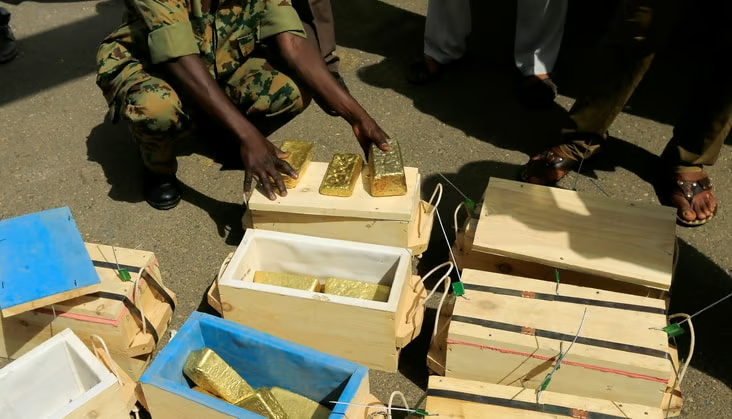
Step-by-Step Guide to Legally Export Gold from DRC
Exporting requires a registered local entity and per-shipment approvals. Here’s a practical 10+ step process based on official and compliant practices.
- Register a Legal Congolese Company
Incorporate via RCCM (Registre du Commerce et du Crédit Mobilier), obtain tax ID (NIF), and comply with residency/tax rules. Foreigners often need a local partner (51% Congolese ownership in some subcontracting cases). - Obtain Mineral Trading / Exporter License (Carte d’Opérateur Minier or similar)
Issued by Ministry of Mines. Allows legal purchase and sale within DRC. Requires proof of financial capacity, premises, and compliance. - For Artisanal Gold: Secure SAEMAPE Authorization and Source from Licensed Cooperatives
Gold must come from approved ASM sites with traceability records. Cooperatives need SAEMAPE technical advice and registration. - Implement Traceability and Due Diligence
Follow OECD 5-step framework: Identify risks (conflict, child labor, smuggling), mitigate, and document supply chain from mine to export. Use CEEC’s E-Trace system. - CEEC Valuation, Assay, and Certification
Submit samples for purity/weight analysis. Obtain:- Certificate of Origin
- ICGLR Regional Certificate (conflict-free)
- Metal Clearance Certificate
Declaration of origin/sale filed 2 days before export.
- Apply for Export Permit (Per Shipment)
Not a blanket license—each shipment needs fresh approval. - Pay All Taxes, Royalties, and Fees (detailed below).
- Pre-Shipment Inspection and Sealing
By CEEC, OCC, and/or others. Joint sampling/weighing. - Customs Clearance via DGDA
Use electronic platform (e.g., GUICE/SEGUCER). Submit full documentation. - Transport and Export
Typically by air cargo from Kinshasa, Goma, or other hubs. Repatriate proceeds as required.
Additional Requirements: Commercial invoice, packing list, bill of lading, insurance, assay reports. All in French where mandated.
Taxes, Royalties, and Export Duties on Gold
Costs are a major barrier and driver of smuggling if too high.
- Artisanal Gold: ~1.5% export duty + other fees.
- Industrial/Processed Gold: Up to 3% or higher.
- Royalties: 3.5%+ on precious metals (can rise if “strategic”).
- Other: Inspection fees (OCC/CEEC), SAEMAPE contributions, provincial taxes, VAT if applicable, super-profit taxes in some cases.
- Total Effective Burden: Historically 10-12%+ including all steps; reforms aim to streamline while capturing revenue.
Proof of payment is mandatory before clearance. Currency repatriation rules apply (e.g., portion back to DRC banks).
Documentation Checklist for DRC Gold Exports
- Company registration docs
- Valid trading/export license
- Supply chain traceability records
- CEEC assay/purity reports and certificates (Origin, ICGLR)
- Commercial invoice and export declaration
- Proof of tax/royalty payments
- DGDA customs forms
- Transport documents
Digital E-Trace integration is increasingly mandatory.
Challenges and Risks in DRC Gold Export
- Informal Sector Dominance: Much gold is smuggled to Uganda, Rwanda, etc.
- Security: Conflict in eastern DRC (Ituri, North Kivu) links to armed groups.
- Corruption and Multiple Taxes: Unofficial “fees” inflate costs.
- International Scrutiny: Dodd-Frank, EU Conflict Minerals Regulation, US sanctions on illicit networks.
- Logistics: Infrastructure issues, bureaucracy (historically 20+ steps).
- Fraud: Fake certificates or gold; always verify partners.
Mitigation: Partner with reputable cooperatives, use third-party auditors, and engage compliant refiners/exporters.
Recent Developments and Reforms (2026)
- Digital traceability (E-Trace by CEEC).
- Multi-ministerial push for formalization and reduced smuggling.
- New refinery and potential preferential deals (e.g., past UAE discussions).
- Focus on local value addition; raw export restrictions in some contexts.
- Cobalt-style quotas/controls may influence gold policy.
Government aims to increase official revenue while supporting ASM formalization via SAEMAPE.

How Foreign Investors/Buyers Can Participate Legally
- Form joint ventures or appoint local agents.
- Invest in ASM formalization projects (e.g., Just Gold-style initiatives).
- Ensure full OECD/ICGLR compliance for market access (Dubai, Switzerland, etc.).
- Consult lawyers familiar with 2018 Mining Code.
Warning: “Easy” or no-license schemes are scams or illegal. Always verify with official sources.
Best Practices for Compliance and Success
- Conduct thorough due diligence on suppliers.
- Budget for 10-15%+ in fees/taxes/logistics.
- Use technology for traceability.
- Engage local experts, notaries, and compliant logistics firms.
- Monitor policy changes via Ministry of Mines or EITI reports.
- Consider ethical premiums for traceable gold.
Conclusion: Legal Gold Export from DRC is Viable but Demands Rigor
Exporting gold from the Democratic Republic of the Congo offers high potential amid strong global prices, but success hinges on full regulatory adherence.
The 2018 Mining Code, CEEC processes, SAEMAPE oversight, and traceability requirements form a robust (if bureaucratic) framework designed to curb illegality and maximize national benefit.
For personalized advice, contact the Ministry of Mines, CEEC, or qualified DRC legal/fiscal experts. This guide is for informational purposes—laws evolve, and professional consultation is essential.