
Dubai Gold Export Procedure: Complete Step-by-Step Guide for 2026
The Dubai gold export procedure is the operational backbone of one of the world’s most valuable commodity flows, and understanding it in precise, practical terms is the difference between a seamless, compliant, profitable transaction and a shipment that stalls in customs, triggers regulatory action, or exposes an exporter to penalties that can reach AED 5,000,000 per violation.
Whether you are a licensed bullion trader managing regular international gold shipments, a mining company routing African or South American doré through Dubai’s refinery infrastructure for onward sale, a corporate treasury officer executing a strategic gold position, or an individual investor seeking to export gold jewellery or investment bars purchased in the Dubai Gold Souk — this guide covers the complete Dubai gold export procedure for 2026 in the detail that actually matters: the licences, the documents, the customs portal, the assay requirements, the VAT treatment, the AML obligations, the logistics framework, the costs, the timelines, and the compliance standards that govern every legal gold export from the UAE.
Why Dubai Is the World’s Premier Gold Export Hub
Before the procedure, the context — because understanding why so much of the world’s gold moves through Dubai is understanding the regulatory and commercial architecture that makes the Dubai gold export process function as efficiently as it does.
Dubai accounts for a significant share of the global physical gold trade, and much of that flows through the Dubai Multi Commodities Centre — the world’s largest free zone by registered company count and home to the Dubai Gold and Commodities Exchange. The DMCC’s infrastructure was specifically designed for commodities trading, with a regulatory environment, vaulting facilities, refinery operations, and international banking connectivity that no other jurisdiction in the region matches.
Dubai’s geographic position — six hours by air from both London and Singapore, four hours from Mumbai, two hours from Nairobi — makes it a natural transit point for gold moving between producing continents and consuming markets. Its zero customs duty on investment-grade gold exports, its zero VAT rate on bullion exports, its 0 percent corporate tax rate for DMCC free zone companies qualifying as Qualifying Free Zone Persons, and its English-language legal system built on common law principles create a commercial environment that consistently outcompetes rival gold trading hubs including Geneva, London, Singapore, and Hong Kong for certain categories of physical gold transaction.
The UAE’s gold market infrastructure includes approximately ten active refineries, three of which hold Dubai Good Delivery accreditation — including Emirates Gold and Al Etihad Gold, which operate under DMCC’s Responsible Sourcing Review Protocol aligned with OECD due diligence guidance. This refinery infrastructure means that raw doré imported from African and South American mining operations can be processed to LBMA Good Delivery standard within Dubai and exported as investment-grade bullion bars to global buyers — a complete supply chain loop within a single regulatory jurisdiction.
Who Needs to Follow the Dubai Gold Export Procedure
The Dubai gold export rules apply to every person, company, or institution moving gold out of the UAE across an international border, regardless of the form of gold, the quantity, or the destination. The specific licensing and documentation requirements vary by the type of exporter and the scale of the transaction, but no gold export from Dubai is exempt from customs declaration and basic documentation obligations.
Licensed commercial gold exporters — companies registered with DMCC, the Dubai Department of Economy and Tourism (DET), or other UAE free zone authorities with specific gold trading or export licences — conduct the majority of Dubai’s gold export volume. These entities are subject to the full suite of DMCC compliance obligations including responsible sourcing, AML/KYC, goAML reporting, and Dubai Customs registration.
Individual travellers carrying personal gold out of Dubai — whether gold jewellery purchased in the Gold Souk, investment coins, or small gold bars — are subject to declaration requirements above certain value thresholds and to the import regulations of their destination country. There is no official maximum on gold exports from the UAE, but gold must be declared if valued above AED 60,000, and the export rules of the destination country apply.
Mining companies and refineries routing gold through Dubai for processing and re-export — primarily operations importing African, South American, or Central Asian doré into UAE refineries — must comply with both import and export documentation requirements, with particular attention to OECD conflict-free sourcing obligations that govern all UAE-based precious metals businesses.
Below is the Dubai Gold Export Procedure: Step-by-Step Guide
Step 1: Obtain the Required Gold Export Licence from DMCC or DED
The foundational requirement for any regular or commercial gold export from Dubai is holding a valid gold trading and export licence from the appropriate UAE authority. Attempting to export gold commercially without this licence is illegal under UAE law and subject to significant financial and criminal penalties.
If you are exporting regularly or in bulk, you need a gold export licence that Dubai issues through DMCC or the relevant authority. The choice between a DMCC free zone licence and a mainland DED licence has direct commercial and regulatory implications that every exporter must understand before applying.
The DMCC gold trading licence is the preferred choice for wholesale exporters, international traders, and companies routing gold through Dubai to global markets. DMCC is a free zone licence ideal for wholesale, international, and B2B gold trading — with access to the DGCX exchange, on-site refineries, and a 0% qualifying income tax rate.
DMCC membership fees run approximately AED 15,000 annually, and physical presence within DMCC premises is mandatory — a flexi-desk may suffice for advisory activities, but trading, manufacturing, and full export operations require dedicated premises that pass SIRA security inspection before licence issuance.
The DED mainland gold trading licence is better suited for retail operations, Gold Souk trading, and direct selling to UAE consumers. DED is a mainland licence best suited for retail operations, Gold Souk trading, and direct selling to UAE consumers. Mainland companies exporting gold must register separately with Dubai Customs for each cross-border movement.
The step-by-step DMCC gold trading licence application process runs as follows: define your specific business activity (trading, refining, import/export, or combination); choose your jurisdiction (DMCC free zone for international trading, DED mainland for retail); reserve your trade name — which must be unique and compliant with UAE naming conventions; submit your initial application with shareholder identification and corporate documents; obtain security approvals and AML classification clearance; secure your office space with a signed lease agreement within DMCC premises; complete all legal documentation including a notarised Memorandum of Association and shareholder resolutions; pay all government and DMCC authority fees; and receive your licence — typically within four to six weeks for standard applications.
Step 2: Source Gold Only From Approved, Compliant Suppliers
The DMCC’s responsible sourcing framework — aligned with the OECD Due Diligence Guidance for Responsible Supply Chains of Minerals from Conflict-Affected and High-Risk Areas — makes supply chain origin documentation a legal requirement, not a best practice recommendation.
Source gold from DMCC-accredited refiners or importers. For gold from Africa (e.g., Uganda), ensure suppliers provide export permits and certificates of origin.
Every piece of gold that enters a Dubai-based exporter’s inventory must be accompanied by documentation tracing its origin from the point of mine extraction through to the UAE border — specifically demonstrating that it was not sourced from conflict-affected mining operations.
DMCC’s conflict-free gold sourcing requirements prohibit member companies from trading gold that originates from or transits through areas where armed groups control mining operations or where systematic human rights violations in mining supply chains have been documented.
The OECD framework applied by DMCC requires exporters to conduct risk-based due diligence on their entire supply chain, maintain records of that due diligence, and submit to third-party review on a defined audit cycle.
Entities under the purview of this regulation must adhere to requirements from the audit period starting from January 2023 and must submit third-party review reports to the Ministry of Economy within 90 days of the completion of the review cycle.
For exporters sourcing from African gold mining regions — particularly high-risk areas in eastern DRC, Sudan, or parts of West Africa — the supply chain documentation burden is the most demanding component of UAE compliance.
Certificates of origin from the source country’s mining authority, OECD-compliant chain-of-custody records, and conflict-free declarations from supply chain counterparts are all required elements of the sourcing documentation package.
Step 3: Assay and Purity Verification by an Approved UAE Assayer
Before a gold export from Dubai can proceed, the gold must be independently tested and certified for purity by an approved UAE assay laboratory. Have the gold tested by an approved assayer — such as Emirates Gold or Al Etihad Gold — to confirm purity meets UAE standards, which require a minimum of 99.5% purity for bullion.
The UAE gold purity standard for investment-grade bullion exports is 99.5 percent minimum fineness — equivalent to 995 millesimal fineness and meeting the LBMA Good Delivery floor requirement. Dubai follows the international 999.9 standard for 24K bullion, meaning that the finest investment bars exported from Dubai meet the four-nines purity benchmark that institutional buyers worldwide specify for their bullion holdings.
The assay process for export purposes involves the approved laboratory receiving the gold consignment, taking representative samples using fire assay or XRF analysis, producing a certified assay report stating the weight, fineness, and elemental composition of the gold, and issuing documentation that accompanies the shipment through customs.
Assay fees run from AED 100 to AED 500 per bar, and handling fees of AED 200 to AED 1,000 apply depending on consignment volume and the specific assay facility used.
For gold jewellery being exported from Dubai, purity testing and hallmarking requirements apply under ESMA (Emirates Authority for Standardization and Metrology) standards, which mandate that gold jewellery sold and exported from the UAE carries hallmarks certifying karat and country of manufacture.
The Emirates Authority for Standardization ensures quality compliance across all gold products leaving the UAE market, and non-hallmarked jewellery may face export delays or rejection at customs.
Step 4: Prepare the Complete Dubai Gold Export Documentation Package
Dubai gold export documentation is the practical heart of the compliance process, and incomplete or inconsistent documentation is the most common cause of customs delays, shipment holds, and regulatory penalties.
Every document must be prepared with care, checked for consistency across all stated weights, values, and descriptions, and assembled as a complete package before the customs declaration is filed.
The mandatory gold export documents required by Dubai Customs in 2026 are as follows:
Commercial Invoice: A detailed invoice prepared by the exporter and addressed to the buyer, stating the full legal names and addresses of both parties, the precise description of the gold (form, karat, weight in troy ounces or grams, number of bars or pieces), the declared value in USD or the transaction currency, the payment terms, and the Incoterms governing the delivery (FOB Dubai or CIF destination are the most common for gold shipments).
The commercial invoice must be consistent with every other document in the export package — any discrepancy between the weight or value stated on the invoice and the customs declaration will trigger a hold.
Certificate of Origin: A document certifying where the gold was mined or refined, issued by the relevant authority in the country of origin or by the Dubai Chamber of Commerce for Dubai-refined gold.
The certificate of origin is a critical conflict-free sourcing compliance document — it links the gold being exported to the documented supply chain that the exporter’s responsible sourcing programme covers.
For African-origin gold processed through UAE refineries, the certificate of origin will typically state the UAE as the country of final refining.
Assay Certificate: The laboratory-issued document described in Step 3, certifying the gold’s weight, purity, and elemental composition. This document must be from an approved UAE assay laboratory and must match the gold described in the commercial invoice exactly.
Export Customs Declaration: The formal declaration filed with Dubai Customs through the Mirsal 2 online portal (described in Step 5), containing all shipment details, declared values, and destination information.
Sales Contract: A sales contract outlining terms, compliant with AML and KYC requirements, specifying that payment will only be made through verifiable banking channels.
The contract must identify both parties with full legal name, registration number, and address, specify the gold quantity and purity, state the price formula (LBMA spot plus or minus an agreed percentage, or a fixed price), define delivery terms and timeline, and include the dispute resolution mechanism.
Air Waybill or Bill of Lading: The logistics carrier’s transport document, confirming the shipment details, declared weight, insured value, and destination.
For air cargo shipments — which represent the majority of Dubai gold export logistics — the air waybill from Emirates SkyCargo, Etihad Cargo, or the specialist precious metals courier is required before customs clearance can be completed.
Insurance Certificate: For export volumes above 1 kilogram, a comprehensive insurance certificate covering the full declared value of the gold shipment is required.
Given gold’s extraordinary value per kilogram, specialist precious metals transit insurance from Lloyd’s of London or equivalent insurers is the professional standard for any meaningful export volume.
Packing List: A document describing the packaging method, total gross and net weight, number of packages, and the shipment method — whether by air, sea, or secure land transport. Each package must be individually described with its contents, weight, and sealing details.
Proof of Purchase: Documentation establishing that the gold being exported was legally purchased or produced — receipts from DMCC-accredited refineries, purchase invoices from licensed UAE gold dealers, or refinery production records for domestically processed material.
Step 5: File the Customs Declaration Through Dubai’s Mirsal 2 Portal
File the customs declaration by submitting all documents through Dubai Customs’ online portal — the Mirsal 2 system — and pay any applicable fees. The Mirsal 2 online platform is Dubai Customs’ primary digital interface for all import and export declarations, and it is the mandatory channel through which every commercial gold export customs declaration in Dubai must be filed.
How to file a gold export declaration on Mirsal 2 requires the exporter to hold an active Dubai Customs registration — a separate requirement from the DMCC or DED trading licence.
The registration process involves submitting corporate documents, trade licence copies, and authorised signatory details to Dubai Customs, receiving a customs code, and activating the Mirsal 2 account before any declarations can be filed.
Within the Mirsal 2 system, the gold export declaration requires entry of the HS code for the specific gold product being exported — investment bars (HS 7108.12), gold doré (HS 7108.11), or gold jewellery (HS 7113.19) each carry distinct classification codes that determine the applicable duty treatment and documentation requirements. The declared value, weight, country of origin, and destination country must all be entered consistently with the accompanying documentation package.
Dubai Customs processes standard gold export declarations within one to two business days in most cases, though complex shipments — particularly those involving African-origin gold subject to enhanced responsible sourcing scrutiny — may require additional review time.
the declaration is approved, a customs clearance number is issued that enables the physical shipment to proceed to the logistics carrier for transport.
Step 6: AML and KYC Compliance — The goAML Reporting Obligation
Anti-money laundering compliance for Dubai gold exporters is one of the most operationally demanding components of the UAE’s gold trading regulatory framework, and it is an area where enforcement has intensified significantly in recent years.
Gold traders must register with the UAE FIU via goAML, implement a documented AML and CFT programme, conduct Customer Due Diligence on all counterparties, screen against UAE Cabinet Decision 74 and international sanctions lists, file Suspicious Transaction Reports, and maintain five-year transaction records. Non-compliance results in heavy fines and potential licence revocation.
The goAML system is the UAE Financial Intelligence Unit’s digital reporting platform, mandatory for all Designated Non-Financial Businesses and Professions — a category that explicitly includes gold and precious metals dealers.
Every licensed gold trader in Dubai must be registered on goAML and must submit Suspicious Transaction Reports (STRs) whenever a transaction raises money laundering or terrorism financing concerns, regardless of whether the transaction is ultimately completed.
Customer Due Diligence requirements for Dubai gold exports include: conducting full identity verification on all buyers using government-issued identification and business registration documents; verifying the ultimate beneficial ownership of corporate counterparties; assessing the source of funds for the purchase; screening all counterparties against the UAE Cabinet Decision 74 sanctions list, the UN Security Council Consolidated List, and relevant national sanctions lists of destination countries; and documenting all of the above in records maintained for a minimum of five years.
The AED 55,000 threshold is critical: Dealers in Precious Metals and Stones are subject to DNFBP requirements for any single cash transaction, or several apparently related transactions, equal to or exceeding AED 55,000. Above this threshold, full customer identification and verification apply.
This cash threshold does not apply to wire transfer transactions, but it is a firm line for any gold transaction involving physical currency — and given the value of gold, the AED 55,000 threshold is crossed at less than 400 grams of gold at current prices.
Administrative penalties for non-compliance range from AED 50,000 to AED 5,000,000 per violation. In serious cases, authorities can ban individuals from the sector and pursue criminal proceedings.
Step 7: Obtain Security Clearance for High-Value Gold Shipments
For gold shipments above defined value thresholds, the Dubai gold export security clearance procedure requires coordination with Dubai Police in addition to the standard Dubai Customs declaration process. Coordinate with Dubai Police for high-value shipments.
This security clearance involves a verification of the shipment documentation, a risk assessment of the shipment route and destination, and in some cases a physical inspection of the packaged gold before it is released to the logistics carrier.
High-value armoured gold transport in Dubai for movement between the exporter’s premises, the assay laboratory, and the cargo terminal is provided by specialist precious metals logistics companies operating under Dubai Police oversight.
The carrier must hold the appropriate UAE precious metals transport licence, and all vehicle movements must follow approved routes with GPS tracking and armed escort for consignments above specified value thresholds.
The security clearance step is not merely a bureaucratic formality. Dubai’s experience as a global gold hub has made its security infrastructure for precious metals one of the most sophisticated in the world, and the clearance process provides exporters with documented proof — useful in insurance and dispute contexts — that the shipment was physically verified and released through an authorised, monitored process.
Step 8: Arrange Logistics and Ship the Gold
Gold shipment logistics from Dubai involves choosing between several transport modes depending on the volume, value, destination, and urgency of the consignment.
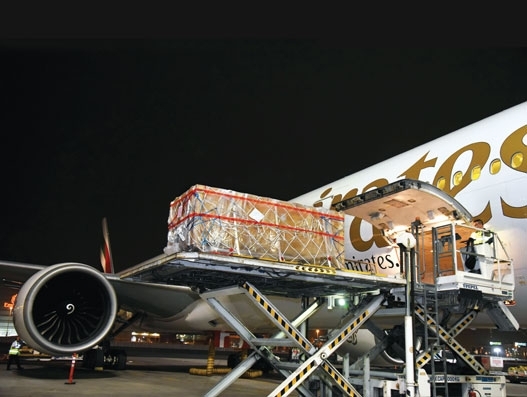
Air freight is the dominant mode for most gold exports from Dubai, reflecting the combination of speed, security infrastructure, and global connectivity that Dubai International Airport (DXB) provides.
Methods include air freight via carriers like Emirates SkyCargo or couriers like DHL for smaller consignments. Emirates SkyCargo — one of the world’s largest air cargo carriers — operates dedicated precious metals handling facilities at DXB, with temperature-controlled, fully secured storage and documented chain-of-custody transfer procedures. Specialist precious metals couriers including Brinks, Malca-Amit, and Loomis International provide door-to-door armoured transport with comprehensive insurance, GPS tracking, and customs documentation management for international gold shipments.
For very large gold consignments — multi-tonne movements between refineries or institutional vaults — sea freight in fully secured, insured containers is used, though this is less common in the Dubai gold export market than in some other commodity trade flows.
Land transport across GCC borders is used for intra-regional movements but is not standard for intercontinental gold export.
Average timelines for Dubai gold exports from documentation preparation through to delivery at destination run five to fourteen days under standard processing, with express options via DXB capable of reducing this to approximately three days for priority shipments.
The timeline breaks down approximately as follows: document preparation takes two to three days; Dubai Customs clearance takes one to two days; and international transit time takes two to seven days depending on the destination city.
Key Regulatory Authorities Governing Dubai Gold Exports
Understanding which body governs which aspect of the UAE gold export regulatory framework prevents confusion and ensures that licence applications, compliance queries, and documentation disputes are directed to the correct authority.
The Dubai Multi Commodities Centre (DMCC) is the primary regulatory and licensing authority for gold traders, refiners, and exporters operating within the DMCC free zone.
It sets and enforces responsible sourcing standards, issues and revokes trading licences, and oversees the Dubai Good Delivery accreditation system for UAE refineries. DMCC’s Rules for Risk Based Due Diligence in the Gold and Precious Metals Supply Chain apply to all DMCC members and are the most operationally significant compliance framework for commercial gold exporters.
The UAE Federal Customs Authority sets national customs policy, while Dubai Customs administers the Mirsal 2 portal and handles practical customs clearance at the emirate level.
All import and export gold declarations are processed through Dubai Customs regardless of whether the exporting company is DMCC-licensed or DED-licensed.
The Emirates Authority for Standardization and Metrology (ESMA) enforces gold purity and hallmarking standards across all gold products sold or exported from the UAE. ESMA compliance is mandatory for gold jewellery and for any gold product carrying a karat marking.
The UAE Financial Intelligence Unit (UAE FIU) administers the goAML reporting system and oversees AML and counter-terrorism financing compliance for all designated non-financial businesses including gold dealers. The UAE FIU operates under the Central Bank of the UAE’s broader financial crime prevention framework and coordinates with FATF, the Egmont Group, and international law enforcement on gold-linked financial crime investigations.
The Ministry of Economy of the UAE oversees responsible sourcing compliance at the federal level, with entities required to submit third-party audit reports under the UAE’s responsible sourcing regulation within 90 days of completing each review cycle.
Responsible Sourcing: The OECD Framework and What It Demands from Dubai Gold Exporters
Responsible gold sourcing compliance in Dubai goes beyond basic AML — it encompasses the full supply chain from mine to refinery to export, with specific requirements for documenting that gold was not sourced from conflict-affected areas, did not involve child labour, and did not contribute to environmental degradation beyond what the applicable national regulatory framework permits.
This is where Dubai’s gold compliance goes well beyond standard AML. AML asks “is this money clean?” Responsible sourcing asks “where did this gold actually come from, and did anyone get hurt along the way?” The UAE has implemented a responsible sourcing regime aligned with the OECD Due Diligence Guidance for Responsible Supply Chains of Minerals from Conflict-Affected and High-Risk Areas.
For exporters sourcing gold from high-risk producing regions — which includes significant portions of sub-Saharan Africa, parts of South America, and certain Central Asian jurisdictions — the OECD five-step framework requires: establishing strong company management systems for supply chain due diligence; identifying and assessing risks in the supply chain; designing and implementing strategies to respond to identified risks; carrying out independent third-party audit of supply chain due diligence; and reporting annually on supply chain due diligence.
The DMCC Responsible Sourcing Review Protocol requires member companies to implement these five steps, maintain supporting documentation, and submit to the third-party review process on the defined audit schedule. Non-compliant DMCC members face licence suspension and reputational consequences that extend beyond the UAE regulatory environment to their international banking relationships and refinery counterparty access.
Common Mistakes That Delay or Invalidate Dubai Gold Exports
The most frequent Dubai gold export mistakes that result in customs holds, regulatory action, or shipment rejection fall into predictable categories that careful preparation eliminates entirely.
Incomplete or inconsistent documentation is the most common problem. A commercial invoice that states a different weight from the assay certificate, or a customs declaration that uses a different value from the sales contract, will trigger a manual review that adds days to the clearance process and may result in a request for corrected documents. Every figure — weight, purity, value, quantity — must be identical across every document in the export package.
Attempting to export gold without an active Dubai gold trading licence or without registering with Dubai Customs before filing the Mirsal 2 declaration is a compliance violation with immediate and serious consequences.
The UAE gold market’s enforcement capability is sophisticated and well-resourced, and the assumption that small volumes or personal-use framing exempts an exporter from commercial licence requirements is frequently wrong.
Sourcing gold without adequate conflict-free documentation — and attempting to export it through the DMCC framework — exposes the exporter to DMCC responsible sourcing violations that can result in immediate licence suspension.
The assumption that Dubai’s position as a gold transit hub means sourcing scrutiny is minimal is the most dangerous misconception in the market, and one that the DMCC has explicitly and repeatedly addressed through enforcement action against non-compliant members.
Failing to account for destination country import requirements creates problems at the receiving end even when the Dubai export procedure was correctly followed. It is not just Dubai’s regulations that matter. Your home country’s import laws can make or break the process.
Import duties, minimum purity requirements, declared value thresholds, and AML documentation requirements vary significantly by destination country, and exporters must understand both ends of the transaction before shipping.
Using non-verifiable payment channels — cash above the AED 55,000 threshold, cryptocurrency transfers, or informal money transfer services — for gold export transactions creates AML violations regardless of the legitimacy of the underlying gold.
Every payment for a Dubai gold export must flow through verifiable banking channels with clear documentation of the payer’s identity and the commercial basis for the transaction.
Dubai Gold Export for Individual Travellers: Personal Allowances and Procedures
For individuals who have purchased gold jewellery, coins, or small bars in Dubai and wish to carry them home personally, the Dubai gold export rules for travellers are simpler than the commercial framework but still require attention and preparation.
There is no UAE-imposed weight or value limit on gold carried out by travellers, but gold above AED 60,000 in value must be declared at Dubai Customs before departure. Failure to declare appropriately creates legal exposure under UAE customs law and the risk of seizure at the departure terminal.
The more critical variable for personal gold export is the import law of the destination country. Many countries impose import duty on gold above defined allowances, require declarations of precious metals carried across the border, or restrict the import of gold coins and bars without specific documentation. India, for example, applies customs duty on gold imports above defined personal allowances.
European Union countries may require declaration of gold above defined value thresholds. Understanding these destination country requirements before purchasing gold in Dubai is essential — the savings on Dubai’s zero-VAT bullion pricing can quickly be offset by unexpected import duties at home.
For carrying gold through Dubai airport, VAT-registered purchases from licensed UAE gold dealers qualify for VAT refund at the airport departure terminal through the Planet Tax Free system — which processes refunds on purchases of jewellery and other gold items carrying the standard 5 percent VAT rate.
Investment-grade bullion bars and coins are zero-rated and therefore not eligible for VAT refund (as no VAT was charged on purchase), but jewellery purchases can generate meaningful refunds on higher-value items.
The Full Dubai Gold Export Timeline: What to Expect at Every Stage
How long does it take to export gold from Dubai? The average timeline for a Dubai gold export runs five to fourteen days, with factors including document preparation taking two to three days, customs clearance taking one to two days, and shipping taking two to seven days depending on the destination. Express options via DXB can reduce the total timeline to three days for priority shipments.
For first-time exporters building their documentation infrastructure — obtaining the DMCC licence, completing Dubai Customs registration, establishing goAML compliance systems, and building supplier due diligence documentation — the initial setup process takes four to six weeks before the first shipment can legally proceed. Once this infrastructure is in place, repeat export transactions move through the five-to-fourteen-day operational timeline.
The practical conclusion is that planning a Dubai gold export requires more lead time than most first-time exporters anticipate, and that the compliance infrastructure — licences, documentation systems, AML programmes, supplier sourcing records — must be built before any commercial transaction can begin, not assembled in parallel with an active shipment.

Dubai’s Position in the Africa-to-UAE-to-World Gold Supply Chain
One of the most commercially significant applications of the Dubai gold export procedure is as the transit and refining hub for gold originating in African producing nations — particularly Uganda, the DRC, Tanzania, Ghana, Zimbabwe, Sudan, and Mali.
African gold moves to Dubai through a combination of formal export channels (with full country-of-origin documentation and licensed logistics) and informal routes that the UAE and producing-country regulators are actively working to formalise.
For African gold exporters seeking access to the global bullion market, routing gold through Dubai offers access to LBMA-standard refining infrastructure, institutional buyer networks, and the documentation framework that transforms artisanal and semi-processed gold into investment-grade material tradable at global prices.
The combination of UAE responsible sourcing requirements and OECD compliance obligations means that African gold entering the Dubai market must be documented to a standard that increasingly mirrors international best practice — creating both a compliance cost and a market access premium for African producers who invest in building that documentation infrastructure.
The Africa-to-Dubai gold trade corridor is one of the most financially significant commodity flows in the world, and the exporter who understands both the producing-country export requirements and the Dubai import-and-re-export procedure is positioned to operate the most efficient and commercially advantageous version of that corridor available in 2026.
Everything You Now Know About the Dubai Gold Export Procedure
The Dubai gold export procedure is not a single form or a single clearance — it is a layered compliance architecture covering licensing, supply chain due diligence, independent assay, customs declaration through Mirsal 2, AML and goAML reporting, security clearance for high-value shipments, and logistics documentation that must all function correctly and consistently for a legal, seamless gold export to proceed.
Done correctly, it is one of the most commercially efficient gold export frameworks in the world — zero duty, zero VAT, 0 percent corporate tax for qualified free zone operators, world-class logistics infrastructure, and deep institutional buyer networks at the destination end.
Done incorrectly — with incomplete documentation, unlicensed operations, inadequate sourcing records, or AML non-compliance — it is a framework that delivers penalties up to AED 5,000,000 per violation, potential criminal prosecution, and permanent exclusion from one of the world’s most valuable commodity markets.
The difference between those two outcomes is preparation, knowledge, and the right partners at every stage of the process.
Understand the procedure. Follow it exactly. Work with licensed, experienced counterparts on both sides of the transaction. And remember that Dubai’s gold market is as unforgiving of carelessness as it is rewarding of professionalism.